
Tagged as: EU Law
European Union Law Lecture
A. Introduction
The European Economic Community (EEC) was established by the Treaty of Rome, signed in 1957 and in force from 1 January 1958. Its original six Member States were West Germany, France, Italy, Belgium, the Netherlands and Luxembourg. The UK became a member on 1 January 1973 under the Treaty of Accession, to which the European Communities Act 1972 gave domestic effect. Attempts were made even at this early stage to challenge entry to the EEC, on the grounds that membership would undermine Parliamentary Sovereignty. A national referendum was held in 1975 on the UK's continued membership of the EEC. The renegotiation of the EEC Treaty at Maastricht in 1992 also led to further challenges in UK courts.
Case in Focus: In R v Foreign Secretary, ex p Rees-Mogg [1994] QB 552, an unsuccessful attempt was made in the courts to prevent the UK from ratifying the Maastricht Treaty.
Political discussions were also dominated by the question as to whether a referendum should precede UK ratification of the Treaty of Lisbon. The Treaty was signed in 2007, ratified by the UK in 2008 and entered into force in 2009. The Lisbon Treaty was the latest in the line of treaties expanding the powers of the European institutions and European law. The Lisbon Treaty substantially amended the two treaties, which are the legal basis upon which the European Union (EU) now stands. These are the Treaty on European Union (TEU) and the Treaty on the Functioning of the European Union (TFEU). These amendments were introduced into UK law by virtue of the European Union (Amendment) Act 2008.
B. European Union Institutions
The EU has many of the institutions that its Member States have, including a court structure and a Parliament. Figure 8.1 shows the three pillars replaced by the Lisbon Treaty in 2009. The EU institutions are described in Table 8.1 below.
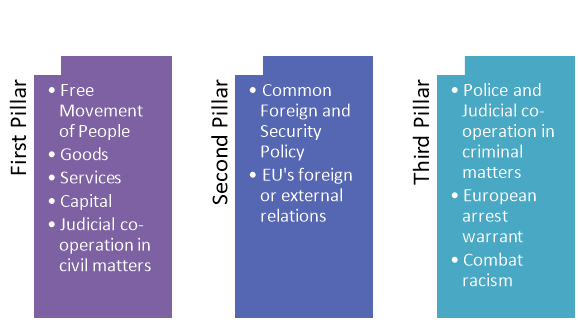
Figure 8.1 Three Pillars of the European Union (Lisa Webley and Harriet Samuels, Public Law, Texts, Cases and Materials (2nd Edition, Oxford University Press, 2012) p.226)
Table 8.1 European Union Institutions
|
EU Institution |
Description |
|
The European Council |
The European Council is made up of the heads of state or government of each of the Member States as well as the European Council President and the President of the European Commission. The EU's High Representative for Foreign Affairs and Security Policy also participates in the European Council Meetings. The European Council sets the EU's general political direction and priorities. It has no legislative function. The Council of the EU and the European Parliament normally act as co-legislators on a proposal from the European Commission. The procedure depends on the legal basis in the Treaties. |
|
The Commission |
The Commission has one member for each Member State. European Council Decision 2013/272/EU maintained this number. Before withdrawal, UK governments nominated senior political figures with a record of service in either the Conservative or the Labour party. Each commissioner has the responsibility for a specific area of activity. The European Council proposes a candidate for President of the Commission, taking account of the European Parliament elections. The European Parliament elects the President by a majority of its members. The Commission as a body requires Parliament's consent before appointment by the European Council. The Commission acts under the political guidance of the President and has two principal functions: to propose legislation and to ensure that EU laws are implemented and applied. The Commission can bring proceedings against EU institutions or Member States that are in breach of their obligations under EU law. Enforcement proceedings were brought against the UK while it was a Member State, including
|
|
The Council of the European Union |
The Council is made up of ministerial representatives from Member States and meets in ten different configurations: general affairs, foreign affairs, economic and financial affairs, justice and home affairs, employment, social policy, health and consumer affairs, competitiveness, transport, telecoms and energy, agriculture and fisheries, environment and education, youth, culture and sport. The Presidency rotates between Member States every six months. The High Representative normally chairs the Foreign Affairs Council. The Council makes policy and approves legislative initiatives proposed by the Commission. The Council meets in public when deliberating and voting on draft legislative acts. Some non-legislative debates are also public. The Lisbon Treaty changed qualified majority voting. Under the usual rule, at least 55% of Member States representing at least 65% of the EU population must vote in favour. A blocking minority must normally include at least four states. Where the Council is not acting on a proposal from the Commission or the High Representative, the threshold is normally 72% of Member States representing at least 65% of the population. Certain matters require simple majorities whereas others require unanimity, such as measures under Article 153(2) TFEU concerning social security and social protection of workers. The Council of the EU is comprised of Member States' government representatives. Various members of government would attend these meetings depending on the issue to be discussed. When the UK was a member, the Home Secretary might attend, or in matters of the Common Agricultural Policy, the Secretary of State for Environment, Food and Rural Affairs would attend. The European Parliament is comprised of MEPs who are directly elected within each Member State in the European Parliament elections. The European Commission is comprised of members who are appointed as a body after Parliament's consent and must act independently in the general interest of the Union. |
|
European Parliament |
Representatives of the European Parliament (MEPs) are elected for five-year periods through elections in the Member States. There are 720 seats in the unicameral Parliament for the 2024-2029 term. Larger states have more seats: Germany has 96, France has 81 and Italy has 76. The UK no longer elects MEPs. Member States use proportional representation, by list or single transferable vote. European political parties exist, and MEPs sit in political groups or as non-attached members. The TEU now provides that the Parliament and the Council jointly exercise legislative functions; under the ordinary legislative procedure, legislative instruments require approval of both the Council and the Parliament. Special legislative procedures assign different roles to the two institutions. The Commission prepares a draft budget each year and presents it for approval to both the Parliament and the Council. |
|
Court of Justice of the European Union |
The function of the CJEU is to ensure that the law is observed in the interpretation and application of the Treaties. The Court of Justice has one judge per Member State and sits in chambers of three or five judges, as a Grand Chamber of fifteen or, exceptionally, as the full Court. Eleven Advocates General (A-Gs) make independent, reasoned submissions in cases requiring an opinion. Judges and A-Gs must be independent and either qualified for the highest judicial offices in their countries or lawyers of recognised competence. Appointments are made by common accord of the Member State governments for six years. Every three years there is partial replacement of the judges and A-G's, although they are eligible for reappointment. The General Court (formerly the Court of First Instance) hears a defined class of cases at first instance, with an appeal on points of law to the Court of Justice. Since October 2024 it has also dealt with preliminary references transferred to it in six specified areas, including VAT and customs. Proceedings before the CJEU include infringement actions under Articles 258-260 TFEU and actions for annulment under Article 263 TFEU:
Under Article 267 TFEU the CJEU has jurisdiction to give preliminary rulings on the interpretation of the Treaties and on the validity and interpretation of EU acts. The national court resolves the dispute between the parties. A national court may refer a question necessary to its judgment. A court of last instance must refer a necessary question of interpretation unless it has already been answered or there is no reasonable doubt. A national court cannot itself declare an EU act invalid. An example of such a reference was made in O'Brien v Ministry of Justice (formerly Department for Constitutional Affairs) [2010] UKSC 34, [2011] 1 CMLR 36, where the UK Supreme Court requested guidance as to whether judges were workers for the purposes of a directive protecting part-time workers against less favourable treatment, in a dispute about pension entitlements of recorders. Following Case C-393/10, the Supreme Court upheld the recorder's pension claim in [2013] UKSC 6. The Court of Justice and the General Court together form the CJEU. The Court of Auditors oversees the EU funds and expenditure. For those countries who have adopted the Euro, the European Central Bank plays an important role. |
C. European Union Law
The EU is different from other international law in that it has created a new legal order. Its sources include the Treaties, the Charter of Fundamental Rights, general principles of EU law, measures adopted by EU institutions and international agreements. The CJEU interprets and develops this law.
- Treaties - these are primary EU law negotiated by Member States; the Charter has the same legal value as the Treaties
- Regulations - these are binding in their entirety and directly applicable in all Member States
- Directives are a form of derivative law. Each Member State to which a directive is addressed must secure the prescribed result, using its choice of form and methods
- Decisions are also derivative law. They are binding in their entirety and, where they specify addressees, bind only those addressees
- International agreements are concluded by the Union with third countries or international organisations. Member States are also parties to mixed agreements
Table 8.2 Sources of European Union Law
|
Source of Law |
Description |
|
Treaty |
The highest forms of law in the EU are the Treaties, which set out the constitution of the EU, but also substantive matters, some give rise to direct effect in national courts. In Van Gend en Loos v Nederlandse Administratie der Belastingen (1963) Case 26/62 the CJEU found that Article 12 of the EEC Treaty had direct effect in the Dutch courts. Not all Treaty provisions have direct effect, but Article 12 contained a 'clear and unconditional prohibition'. Where the treaty provision has direct effect between two private parties, this is referred to as horizontal direct effect. When it is relied upon against the State, this is known as vertical direct effect. |
|
Regulations |
Article 288 TFEU empowers the institutions to 'adopt regulations, directives, decisions, recommendations and opinions'. Regulations have general application in the sense that they are directly applicable in all Member States and are binding in their entirety. The CJEU held in Case 93/71 Leonesio v Italian Ministry for Agriculture [1972] ECR 287 that as a general principle 'because of its nature and its purpose within the system of sources of Community law' a regulation 'has direct effect and is, as such, capable of creating individual rights which national courts must protect'. Sufficiently clear, precise and unconditional provisions of regulations may have horizontal as well as vertical direct effect. |
|
Directives |
Directives bind the Member States to which they are addressed as to the result to be achieved (Art. 288 TFEU), but the national authorities have discretion as to form and methods. New legislation is unnecessary if existing national law already secures the result. If a Member State fails to implement or correctly implement a directive by the deadline, an individual may rely against the state on provisions which are sufficiently clear, precise and unconditional (Case 41/74 Van Duyn v Home Office [1974] ECR 1337). Directives can only have vertical and not horizontal direct effect: In Cases 152/84 Marshall v Southampton and South West Hampshire AHA [1986] ECR 723, it was held that although a directive might only have a vertical direct effect, it may nevertheless be relied upon against a state, when that state was acting as an employer as opposed to as a public authority. The CJEU has categorised the scope of public bodies broadly. This includes bodies subject to state authority or control, and bodies entrusted by the state with a task in the public interest and given special powers for that purpose (Farrell v Whitty, Case C-413/15). Directives have been enforced against
|
|
Decisions |
Decisions are binding in their entirety. A decision which specifies those to whom it is addressed is binding only on them. |
|
Recommendations and Opinions |
These have no binding force. |
Exam Consideration: Direct effect is a topic of fundamental importance and is found in exam papers on a regular basis. You should read a wide range of case law on the topic in order to achieve a comprehensive understanding of the direct effect of the various pieces of the EU legislation and Treaties and whether direct effect acts between the state and the individual or between private individuals.
Case in Focus:
Francovich v Italian State (Joined Cases C-6/90 and C-9/90) [1991] ECR I-5357 concerned Directive 80/987/EEC, which required Member States to guarantee employees' outstanding wage claims when an employer became insolvent. Italy failed to implement this Directive. The beneficiaries and the content of the guarantee were identifiable, but the directive did not identify the body liable to pay. The employees could nevertheless claim damages from the state. State liability requires a rule intended to confer rights on individuals, a sufficiently serious breach and a direct causal link to the loss. Complete failure to transpose by the deadline is a sufficiently serious breach.
D. EU Law and the British Constitutional Law
The UK is a dualist state with respect to international law. A treaty may bind the UK internationally without legislation, but it does not of itself alter domestic law. Monist states on the contrary are those in which ratified international treaties become domestic law without any further action beyond the state ratifying the relevant treaty.
The Treaty of Rome provided for proceedings against a Member State that failed to fulfil its obligations. The UK Parliament enacted the European Communities Act 1972 (EC Act) in order to give effect to community law in the UK. Section 2(1) gave domestic effect to rights and obligations which the Treaties required to take effect without further enactment. Section 2(4) required existing and future enactments to be construed and have effect subject to section 2.
Case in Focus:
In Garland v British Rail Engineering Ltd [1983] 2 AC 751, Lord Diplock interpreted the Sex Discrimination Act 1975 consistently with the directly effective equal pay obligation in Article 119 of the EEC Treaty. Where a conforming interpretation was impossible, the 1972 Act required the court to disapply an inconsistent domestic provision to the extent necessary to give effect to a directly effective rule of Community law.
Section 3 EC Act provided that questions as to the meaning or effect of the Treaties were to be treated as a matter of law and either referred to the CJEU or determined in accordance with principles laid down by and relevant decisions of the European Court. The CJEU does not interpret the domestic jurisdictions national laws, it makes rulings as to the meaning of provisions of EU law where domestic courts are in doubt and refer a question on a point of EU law to it for a ruling.
Exam Consideration: Distinguish the effect of the EC Act 1972 during membership from the effect of the Withdrawal Agreement and the domestic legislation retaining EU-derived rules after the transition period.
Concerns about the implication of membership of the EU for parliamentary supremacy have existed in the UK since the UK joined the EEC in 1973. Certain individuals have expressed these concerns through the UK courts.
Case in Focus:
Blackburn v Attorney-General [1971] 2 All ER 1380, CA. Mr Blackburn brought two actions against the Attorney-General in which he sought declarations that, by acceding to the Treaty of Rome, the government would unlawfully surrender sovereignty permanently. Blackburn referred to Costa v ENEL [1964] CMLR 425, 455 in which it was acknowledged that EEC Member States had limited their sovereignty. The Court of Appeal found that treaties only take precedence of UK law to the extent that Parliament instructs the courts to do so. Parliament cannot bind its successors but Mr Blackburn argued that in acceding to the Treaty of Rome it was doing so since it was irrevocable. Lord Denning raised the question as to whether the UK was at liberty to leave the EEC, but left the question unanswered.
As mentioned in chapter 5, treaty-making is generally a prerogative power. The courts declined to prevent accession in Blackburn, but can determine the legal limits of the prerogative. In R (Miller) v Secretary of State for Exiting the European Union [2017] UKSC 5, the Supreme Court held that ministers needed statutory authority to give notice of withdrawal under Article 50 TEU. There are a number of cases from the CJEU, which consider the way in which EU law interacted with the domestic legal system during UK membership.
Case in Focus:
NV Algemene Transport- en Expeditie Onderneming Van Gend en Loos v Nederlandse Administratie der Belastingen (1963) Case 26/62 concerned a conflict between Dutch customs regulations and the EEC Treaty. The ECJ held that Article 12 EEC Treaty had direct effect and confirmed that an individual could rely upon it within a national court, without the need for further legislation to be enacted in the Member State.
Case in Focus:
Flaminio Costa v ENEL (1964) Case 6/64 ECR 585, 593-4 provided insight into the way the ECJ viewed the European Community, and established the precedence of Community law. The ECJ stated:
"By creating a Community of unlimited duration, having its own institutions, its own personality, its own legal capacity and capacity of representation on the international plane and, more particularly, real powers stemming from a limitation of sovereignty or a transfer of powers from the States to the Community, the Member States have limited their sovereign rights, albeit within limited fields ..."
Article 189 of the EEC Treaty already provided that regulations were directly applicable. Costa relied on that provision in explaining why later national law could not take precedence over Community law. The ECJ has at certain times expanded the terms of European legal supremacy beyond that which had been understood during negotiations around European Treaties.
Case in Focus:
In Case 11/70 Internationale Handelsgesellschaft mbH v Einfuhr-und Vorratsstelle für Getreide und Futtermittel [1970] ECR 1125, the ECJ confirmed that EU law derived from Treaty law could not be invalidated by reference to a rule of national law, even a constitutional rule. The Court also recognised fundamental rights as general principles of Community law.
Case in Focus:
Amministrazione delle Finanze dello Stato v Simmenthal [1978] ECR 629, affirmed that national courts must give full effect to directly effective provisions of Community law 'if necessary refusing of its own motion to apply any conflicting provision of national legislation, even if adopted subsequently'.
As a result of these precedents, the UK courts had to address the priority given to Community law under the EC Act 1972. In Pickstone v Freemans [1989] AC 66 the House of Lords interpreted the relevant statutory provisions in line with EU law. Similarly, in Litster v Forth Dry Dock and Engineering Ltd [1990] 1 AC 546, the House of Lords interpreted UK law to accord with an EU Directive by reading words into the implementing regulations. The Courts began to find it more and more difficult to rely upon their interpretive obligation to create findings of law that accorded with European law.
Case in Focus:
In Factortame Ltd and others v Secretary of State for Transport (Factortame No.1) [1990] 2 AC 85, HL the High Court requested a preliminary ruling from the ECJ to determine the compatibility of the Merchant Shipping Act 1988 with the EC Treaty. A temporary injunction was sought by the applicant fishermen. The relevant parts of the 1988 Act were disapplied. The Court of Appeal reversed the High Court's decision holding that the High Court could not disapply Acts of Parliament. After a reference to the ECJ on interim relief (Case C-213/89), the House of Lords granted relief in Factortame (No. 2) [1991] 1 AC 603. On the substantive reference (Case C-221/89), the ECJ held that Community law precluded the disputed nationality and residence requirements.
The case makes clear that during UK membership, conflicting domestic law had to be set aside so far as necessary to give effect to a directly effective provision of EU law. This of course has implications for parliamentary supremacy and for UK constitutional law.
D. Nicol, 'Britain's transnational constitution' [2008] 61(1) Current Legal Problems, 125, 127-8,
International law presents a spectrum, with some regimes being weak and others are flouted with impunity. The EU, WTO and ECHR are on the stronger side of the spectrum, with EU law being the strongest of all. There is only EU law which enjoys a 'quasi-federal status vis-à-vis national law'. EU law has a unique constitutional impact since it requires courts of Member States to enforce directly effective EU law even when it conflicts with a provision of domestic law. Three of the six original Member States intervened in the landmark case of van Gend en Loos to oppose the creation of direct effect, but were overruled by the ECJ. The preliminary reference system has been effectively deployed by the ECJ to monitor national laws for their compatibility with EU law.
Referring back to Blackburn v Attorney-General [1971], does this mean that the UK has limited its parliamentary supremacy for all times? Since the UK has left the European Union, this is clearly not the case, but the courts were challenged with making decisions on this basis.
Case in Focus:
In Thoburn v Sunderland City Council [2002] EWHC 195 Admin, Laws LJ held that there was no conflict between EU law and UK law that triggered the doctrine of implied repeal, which is invoked when the provisions of a later Act contradict the provisions of an earlier one. He also rejected the argument of Sunderland City Council that the EC Act 1972 was effectively entrenched within the UK constitution and could not be repealed. Laws LJ clarified the following points:
1. Rights and obligations under directly effective provisions of Community law were incorporated into UK law as a result of the EC Act 1972. Inconsistent UK legislation (even primary) had to be set aside to the extent of the conflict.
2. The EC Act 1972 was a constitutional statute. Repeal required express words or words so specific that Parliament's actual intention to repeal was irresistible.
3. This special status is a product of common law, not EU law.
4. The UK's fundamental relationship with EU law rests on domestic legal powers.
The EC Act 1972 was thus capable of repeal and Parliament had not bound its successors. This makes Factortame an expression of the rules of Parliamentary sovereignty. The vote on 23rd June 2016 did not itself change the law. Parliament subsequently authorised notification of withdrawal and repealed the 1972 Act. Part Two of the Withdrawal Agreement protects the residence and related rights of UK and EU nationals and their families who fall within its scope.
E. European Union Act 2011 and the Lisbon Treaty
In the Lisbon Treaty, the EU drew a clearer line between the competencies of Member States and those of the EU. Under the European Citizens' Initiative, one million EU citizens, meeting minimum thresholds in at least a quarter of Member States, can invite the Commission to propose a legal act within its powers. The Commission must respond but need not propose legislation. Article 6 TEU gave the Charter of Fundamental Rights of the European Union the same legal value as the Treaties. Protocol No 30 did not give the UK a general opt-out (N.S., Joined Cases C-411/10 and C-493/10).
S. Burns, 'An incoming tide' [2008] 158 New Law Journal 44, 44-6
Lord Denning noted in Bulmer (HP) Ltd v J Bollinger SA [1974] Ch 401 at 418-9, that the impact of EU law was like an incoming tide flowing up the UK legal system. Burns considers that tide to be more of a Tsunami, particularly in the light of the Lisbon Treaty. The Treaty amends the TEU; Article 1 states that the Union shall replace the European Community.
Article 3 TEU states that the Union aims to promote peace, and to create an area of freedom, without frontiers. It refers to an internal market, and sustainable development, aiming towards full employment and an improvement of the quality of the environment. Article 3 also provides for economic and monetary union, whose currency is the euro. Article 4(2) requires the Union to respect essential state functions, including maintaining law and order, and reserves national security to each Member State. Article 5 governs conferral, subsidiarity and proportionality. Article 50 TEU provides that 'any Member State may decide to withdraw from the Union in accordance with its own constitutional requirements'.
The European Union Act 2011 brought into the law the requirement that certain proposals to transfer competence or power from the UK to the EU be put to a referendum of the UK electorate, before the UK government was to be empowered to enter into such a treaty. The rapid growth of the EU and its competencies had given rise to concern in the UK and other EU Member States. Certain members of the Conservative party in particular wished to reclaim powers from Brussels. The Conservative party who were the dominant party in the 2010-2015 Coalition government introduced the European Union Act 2011 (EU Act 2011); it provided that specified changes required both an Act of Parliament and approval in a referendum. The 2011 Act has since been repealed.
Section 2 required a ministerial statement and an Act approving a treaty amending or replacing the TEU or TFEU, together with satisfaction of the referendum or exemption condition. The exemption condition required the approving Act to state that the treaty did not fall within section 4. Section 3 applied similar arrangements to decisions under Article 48(6) TEU and included a significance condition for certain changes.
F. The European Union Referendum and Brexit
As part of his parties manifesto in the 2015, General Election David Cameron (the Prime Minister) promised to hold a referendum on the UK's future in the European Union. The referendum was held on 23rd June 2016, the leave campaign being support by campaigners from the Conservative Party. The UK voted to leave the EU, with 52% of those who voted opting to leave. The turnout for the referendum was 72.2%, with more than 30 million people voting. [Brian Wheeler and Alex Hunt, 2 October 2016, Brexit: All you need to know about the UK leaving the EU, http://www.bbc.co.uk/news/uk-politics-32810887]. David Cameron, the Prime Minister resigned after the referendum and Theresa May took over. Negotiations on what leaving the EU would mean for the UK addressed trade with the EU and the situation of EU nationals resident in the UK and UK nationals resident in the EU.
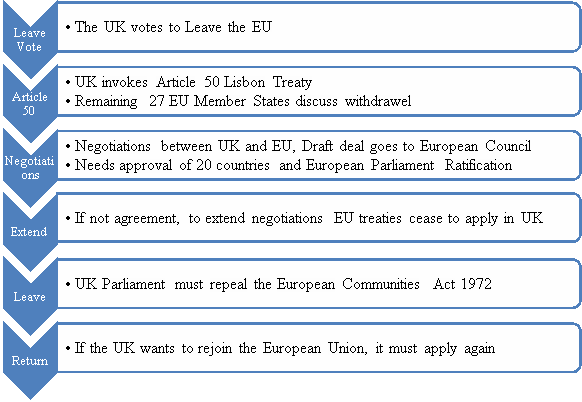
The European Union (Notification of Withdrawal) Act 2017 authorised the Prime Minister to give notice under Article 50 TEU, introduced by the Lisbon Treaty. Theresa May notified the European Council on 29 March 2017. The two-year period was extended by agreement, and the UK left on 31 January 2020. The European Union (Withdrawal) Act 2018 repealed the European Communities Act 1972 on exit day. The 1972 Act continued to have effect with modifications during the transition period, which ended on 31 December 2020.
| Leave vote | The UK voted to leave the EU on 23 June 2016. |
|---|---|
| Article 50 | The UK notified the European Council on 29 March 2017. The remaining 27 Member States discussed withdrawal. |
| Negotiations | The European Council set the guidelines. The Council of the EU concluded the Withdrawal Agreement by qualified majority after the European Parliament gave its consent. |
| Extension | The European Council and the UK extended the negotiating period by unanimous agreement. |
| Leave | The UK left on 31 January 2020. The European Communities Act 1972 was repealed, with its effect temporarily saved during the transition. |
| Return | If the UK wishes to rejoin the EU, it must apply again under Article 49 TEU. |
Figure 8.3 The procedure for UK withdrawal from the European Union (adapted from the 2016 figure, Brian Wheeler and Alex Hunt, 2 October 2016, Brexit: All you need to know about the UK leaving the EU, http://www.bbc.co.uk/news/uk-politics-32810887)
Exam Consideration: Distinguish legal withdrawal from the end of the transition period. The UK's departure answers the question that Lord Denning left open in Blackburn. UK domestic law continues to give effect to the Withdrawal Agreement, including specified EU rules applicable in Northern Ireland under the Windsor Framework.
Hands on Example - European Union Law
The following scenario aims to test your knowledge of the topics covered in the chapter on European Union Law. The answers can be found at the end of this section. Make some notes about your immediate thoughts and if necessary, you can go back and review the relevant chapter of the revision guide. Working through exam questions helps you to apply the law in practice rather than just having a general understanding of the legal principles. This should help you be prepared for particular questions, which may be presented in the exam.
Scenario
Part A: Suppose the European Commission proposes a Regulation that is approved by the Parliament and the Council in 2013 which provides that all citizens in European Union Member States shall be entitled to a minimum full time contract of work of 35 hours a week. The aim of the regulation is to outlaw zero hour's contracts and guarantee a minimum number of hours for full time work. In 2015, the UK Parliament passes the Minimum Full Time Hours Act 2015. This Act provides for a minimum hours’ contract for full time work at 28 hours per week.
In 2016, Barbara works for Shorts Direct as a full time staff member. She has a contract, which guarantees her 28 hours work a week. Barbara objects and requests a minimum of 35 hours a week, relying upon the EU Regulation. Shorts Direct rely on the Minimum Full Time Hours Act. Advise Barbara as to whether the EU Regulation or the Minimum Full Time Hours Act 2015 determines her rights.
Part B: Explain the procedure that the UK followed to leave the European Union, and the extent to which EU law subsequently continued to apply. Be careful to distinguish between the legal and political process involved in withdrawing from the EU.
Suggested Answers
A) This question might look straightforward, but there are a number of elements to the answer. The UK courts have jurisdiction to interpret and apply an Act of Parliament, once it has received royal assent, subject to its commencement provisions. There are a number of cases you might want to refer to here, including Stockdale v Hansard [1837] Eng R 487 and Pickin v British Railways Board [1974] AC 765 HL.
The underlying question is whether section 2 European Communities Act 1972 could in 2016 be expressly or impliedly repealed, which would enable the UK Parliament to pass legislation in contravention of an EU regulation. You should explain the rules of express and implied repeal by reference to Vauxhall Estates Ltd v Liverpool Corporation [1932] 1 KB 733 and Ellen Street Estates v Minister of Health [1934] 1 KB 590, [1934] All ER Rep 385. You should consider whether a provision of an Act of Parliament can protect a statute from amendment or repeal.
You need to consider the supremacy of EU law, as provided for in section 2 European Communities Act 1972. You should also consider the views of the House of Lords in Factortame Ltd and others v Secretary of State for Transport (Factortame No.1) [1990] 2 AC 85, HL, and the subsequent grant of interim relief in Factortame (No. 2) [1991] 1 AC 603, which makes clear that domestic law must be set aside if necessary to give effect to a directly effective provision of EU law.
You should also refer to Thoburn v Sunderland City Council [2002] EWHC 195 Admin, where it was confirmed that the EC Act 1972 gave domestic effect to directly effective EU rights and obligations and that inconsistent legislation must be set aside. The EC Act 1972 was a constitutional statute and could not be repealed by ordinary implication.
On the facts given, the 2015 Act sets a minimum of 28 hours. A guarantee of 35 hours satisfies both minimums. In 2016 Barbara could rely against Shorts Direct on the clear, unconditional right conferred by the assumed Regulation if she fell within its scope. If the 2015 Act prevented enforcement of that right, the court would disapply it to the extent of the conflict.
B) The referendum did not itself withdraw the UK from the EU. Article 50(1) TEU provides that "Any Member State may decide to withdraw from the Union in accordance with its own constitutional requirements". Following Miller [2017] UKSC 5, Parliament authorised the Prime Minister to notify the European Council. The UK gave notice on 29 March 2017.
The European Council set the guidelines for the negotiations. The Council of the EU concluded the Withdrawal Agreement on behalf of the Union after the European Parliament gave its consent. The required qualified majority was at least 72% of the participating states (20 of the remaining 27), representing at least 65% of their population. The later Trade and Cooperation Agreement deals with trade and other aspects of the future relationship.
Under Article 50(3) the Treaties cease to apply to the withdrawing state when the withdrawal agreement enters into force or, failing that, two years after notification unless the European Council unanimously agrees an extension with that state. Before withdrawal, notification can also be revoked unilaterally by an unequivocal and unconditional decision in accordance with the state's constitutional requirements (Wightman, Case C-621/18). The UK obtained extensions and left under the Withdrawal Agreement.
The European Union (Withdrawal) Act 2018 preserved much EU-derived law at the end of the transition period. The retained EU law remaining at the end of 2023 became known as assimilated law. The Retained EU Law (Revocation and Reform) Act 2023 abolished the general principle of EU supremacy for matters occurring after 2023. Under section 6 of the 2018 Act, earlier CJEU case law can still bind UK courts, subject to rules on departure, while later decisions can generally be taken into account. Section 7A gives priority to applicable Withdrawal Agreement obligations. The CJEU retains jurisdiction on specified matters, including references on citizens' rights under Article 158 of the Agreement and on EU rules applicable under the Windsor Framework.
Law Teacher writing support
Writing a law essay?
We choose a writer who is an expert in your area of law and qualified to at least the academic level you select. Most of our writers hold a master’s degree or PhD, have teaching experience, or both.
Send us your question and, if you wish, any marking criteria. We’ll write an essay to your instructions.

Cite This Module
To export a reference to this article please select a referencing style below: